
The DSNY announced new proposed rules for expansion of the containerization pilot program. Here’s what that means for buildings in Manhattan CD 9, Brooklyn CD 2, and beyond.
Existing Pilot Program
In 2024, DSNY finalized rules for the first-ever containerization pilot program, taking place in Manhattan Community District 9. As a result of the pilot, this District is the first in NYC to containerize 100% of its trash.
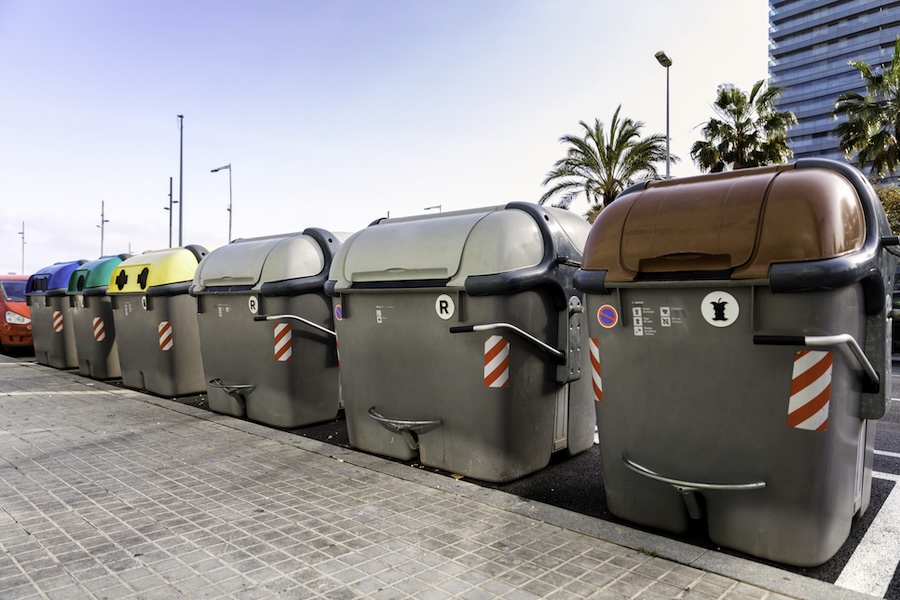
Depending on a building’s size, properties in the district must use a SOSC – a Stationary On-Street Container. Mid-sized buildings can also opt into using SOSCs, or can choose to use approved individual bins to manage trash. Smaller buildings (1 – 9 units) must use approved individual bins.
SOSCs are also known as Empire Bins. Per the Department:
Empire Bins are stationary, on-street containers assigned to a specific property, solely for the use of that property. These bins are locked, accessible only by building staff and waste managers using access cards assigned to the bins. Each Empire Bin can hold approximately four cubic yards of waste, serviced by new DSNY side-loading trucks.
We did a deep dive into the Containerization program here, on the blog.
Pilot Program Expansion
The DSNY is continuing the pilot program with a broader rollout – expanding with specific additional rules and across more Districts. Here’s a breakdown of what’s included in the proposed rules.
Building Definitions
As part of the proposed rules, DSNY would explicitly name building groupings established in the original pilot program:
- Large residential buildings: 31+ dwelling units
- Medium residential buildings: 10 – 30 dwelling units
Both of the above definitions contain the exclusion “other than such a building for which the department collects refuse from a loading dock or other location other than a street or curb.” While “small” buildings don’t get an official definition here, residential properties with 1 – 9 units make up the remainder of the groupings.
Date Extension & Expansion
If approved, these rules would extend the pilot program in Manhattan CD 9 to October 15, 2027. It would also set an implementation date of October 15, 2025 for all medium residential buildings in this District that are currently not using SOSCs or Department-approved containers. Medium buildings would be able to opt into SOSCs during the application period, set for July 1 – July 31st. Given that timeframe, we expect the rules to be approved at least before then.
Expansion To Brooklyn CD 2
Another Community District would also be included in the pilot program. Brooklyn CD 2 (Downtown Brooklyn, Boerum Hill, Brooklyn Heights, Fulton Ferry, DUMBO, Vinegar Hill, Fort Greene, Clinton Hill and Brooklyn Navy Yard) would be part of this year’s opt-in and assignment timeframes, with large buildings being assigned SOSCs and medium buildings being able to opt-in. Implementation and pilot end dates would be the same as Manhattan CD 9, noted above.
Pilot Program Changes
Maintenance and Cleanliness Requirements
The rules have been expanded to include snow and ice as part of the cleaning requirements for SOSCs (in addition to existing debris, vermin, graffiti, etc.). Additionally, residential buildings must keep the following areas free of all trash, debris, snow, and ice:
- The entire area between any 2 stationary on-street containers, if the building has multiple containers;
- The entire area between any stationary on-street container and any adjacent bollard or street marking applied by the Department; and
- The area of the roadway extending 1 1/2 feet beyond such stationary on-street container from all sides
Training & Materials
Residential buildings using SOSCs must distribute training materials provided by the Department to employees, and provide responsible employees with protective gloves. The building may also provide other PPE they determine is necessary for setting out trash within the SOSC.
Enforcement
Per the rules, no person shall intentionally damage, alter, or vandalize any SOSC, including – but not limited to – the building owner or building employees. Failure to abide by this and other rules will result in violations, with penalties starting at $100 and increasing to $300 for third and subsequent violations issued within a 12-month period.
Next Steps
In April 2026, the Mayor’s office announced expansion of the program to more districts beyond Manhattan 9 and Brooklyn 2.
The goal is that six new districts will have 100% containerization by the end of 2027, with full citywide implementation by the end of 2031.
Here are the planned expansion districts:
- Brooklyn Community District 8 (Prospect Heights, Crown Heights, Weeksville)
- Bronx Community District 2 (Hunts Point, Longwood)
- Bronx Community District 5 (University Heights, Mount Hope, Morris Heights, Fordham Heights)
- Manhattan Community District 2 (West Village, SoHo, Little Italy, Greenwich Village, Nolita)
- Queens Community District 2 (Sunnyside, Hunters Point, Woodside)
- Staten Island Community District 1 (North Shore)
We’ll keep you posted on when these rules are finalized, any information for the above expansion plans, and links for when the pilot program application period is open.
Related Articles

About the Author

